By Ronald de Jong
Fadlog Tubad Blaan, this means; “Don’t give up Blaan” strong and promising words coming from a remarkable woman. Her name is Maricel Salinda Kasaligan; she is a pure blooded Blaan and is living in Malungon, Sarangani province on the island of Mindanao, Philippines. Next to being a full time wife, mother of four and teacher, Maricel is dedicated to revitalize and preserve the unique culture of her Blaan tribe.
It is clear that this will not be an easy task, the traditional Blaan culture is diminishing because of the influences of the modern Philippine society. Some Blaan people have abandoned their tribal roots and embraced modern life, but despite this still many are living below poverty level. There are tribal communities in the Southern parts of Mindanao that until nowadays suffer from marginalization. There is hardly any access to basic social services, primary education and not much chance to engage in the local economy.
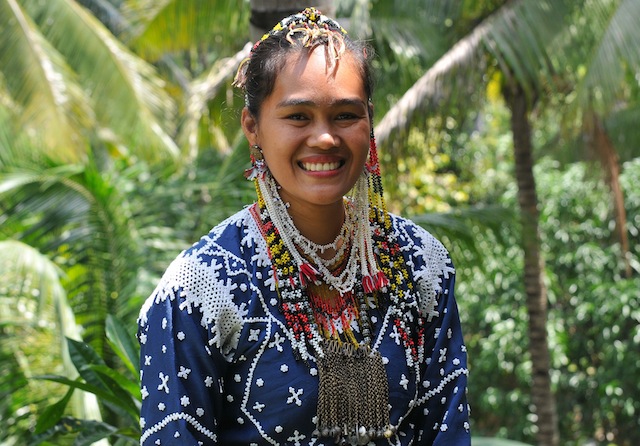 Maricel Salinda Kasaligan, a Blaan from Malungon, Sarangani, says “Fadlog Tubad Blaan” (Don’t give up Blaan). Photo by Ronald de Jong
But just like Maricel there are numerous tribes’ members that won’t give up on their archaic traditions and cultural identity. Maricel is seeking help from these people and the local government for her “Tabih Project.”
Tabih is the term for the finished hand woven abaca cloth and also refers to the traditional Blaan tubular skirt. Her project aims the encouragement of the skilled artisans in her tribe to teach the younger generation the arts of Tabih weaving, brass making, embroidery, basket weaving, mat weaving and the making of native weapons.
In addition the youngster will be trained in native Blaan dancing and playing the Blaan instruments. All these practices will be brought together under the roof of a typical Blaan house, known as “Bong Gumne”, the structure will be located in Malungon, Sarangani Province and will be a combination of a center of knowledge and a school of living tradition. A place that will be open for motivated students and visitors from all over the world.
Sharing knowledge is not new to Maricel. She is the oldest of seven siblings and during her childhood Maricel grew up with her grandparents. Her strict but lovable grandmother woke her up every morning by playing the “Fuglung”, (boat lute). The wonderful sound of this native instrument and wise lessons from her grandmother made Maricel realize that she had to build her future and that of her tribe as well. Maricel is determined in her endeavor and talks with passion about her dreams, her dark brown eyes are sparkling when she explains the reasons behind the project.
“We need to help our people to create a livelihood for the Blaan community, our youth and the urban poor, in same manner we have to preserve the Blaan culture for future generations. To accomplish this, the Blaan tribe, the local government, other cultural organizations, private individuals and trade and industry must go hand in hand, we can’t do this just on our own,” she said.
“Unfortunately there are several persons that are promoting, or rather selling, our culture and taking advantage of it without being Blaan themselves or simply don’t have the right knowledge or information. And there is always a lasting problem of raising funds; this is going to be time-consuming and a very difficult venture. At present not many people are willing to give away their hard-earned money, but I am convinced this project will benefit us all,” Maricel added.
In spite of the efforts made by the local government, “the loss of our cultural identity becomes more likely, we need to work together and create a system that will secure that the practices are not abandoned but passed on to our children.”
Maricel also recognizes the need to “get rid of the subtle prejudice and reduce the tendency to use false stereotypes with regard to the Blaan people. Most people are disrespectful and unaware about the Blaan culture, often the tribe and their name are discriminated, the word ‘Blaan’ nowadays has become a synonym for ignorance or stupid.”
One thing is for sure; Maricel is proud to be Blaan, she has a commitment and won’t give up, she knows that preserving the Blaan culture within the modern Mindanao way of life will be a huge challenge but also a great opportunity to show the world the ancient old culture that is an inseparable part of this riveting tribal community. (Ronald de Jong describes himself as an “independent and completely self-taught travel photographer and writer” who was born and grew up in the Netherlands, “but consider the island of Mindanao in the Philippines my second home. His photographs and articles have been published in various magazines and other periodicals around the world. He is the author of a travel guide titled “Mindanao, from Samal to Surallah” and a book about Filipino street food named “Extreme Measures.”)