Lanao del Sur. Three months after the siege, there’s an overpowering sense of gloom and frustration as paper and plastic cover the windows inside the teacher’s lounge of a small elementary school. Its occupants are Marawi siege survivors who want to keep the light out. They don’t feel well and spend the entire day on the dusty cold cement floor that’s littered with their trash. They rarely get up to move around and just wait, oblivious to their children’s shouting and fighting.
The survivors have different ways of coping. Adults are like zombies while children fight like they’re flushed with adrenaline. They talk in loud voices and try to outmaneuver each other for what they think are food and materials for distribution. They have very short attention spans and are easily distracted in their play. In the presence of nervous and short-tempered adults, children get spanked, pinched, slapped and shouted at every day. Such is the debilitating effect of war. It breaks down formerly loving and disciplined communities.
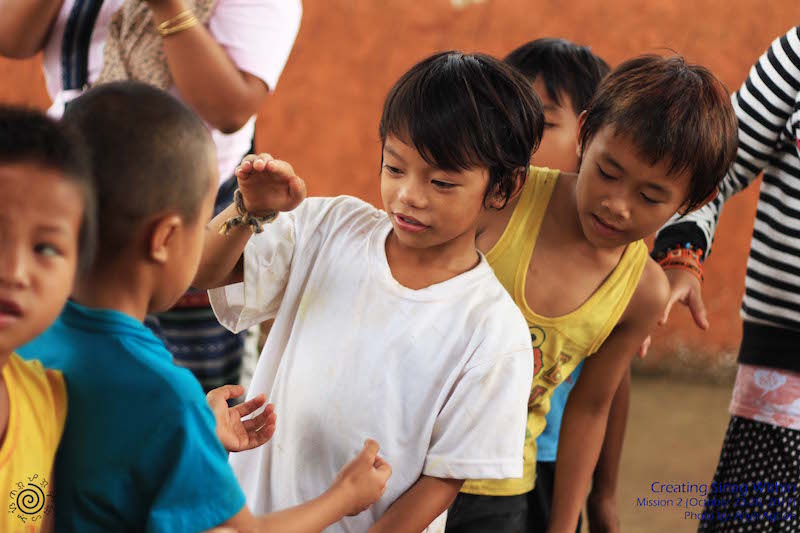 On the third day of Emergency Pedagogy, children could pass the ball without dropping it and could play without fighting. Photo by ROSAN ALIYA AGBON
One of the first to do something about it is Rosan Aliya Agbon, founder of Kids for Peace (KIDS) whose story started seventeen years ago when she became aware of the realities of war. Since then, KIDS has been conducting psychosocial sessions to help survivors move forward from the traumatic experience.
Aliya anticipated that traumatized survivors of the Marawi siege would need help getting back on their feet.
That’s how the six day health/nutrition/psycho-social relief mission, Creating Sinag Within, was born. Twenty-six volunteers from all backgrounds responded to Aliya’s call to collaborate – including six Social Work graduates who are themselves victims of the siege.
“We are the lucky ones because we are living with our relatives and our parents still have their jobs,”says Suli, a Social Worker graduate. She and her batchmates were in the middle of their board review in school when the siege broke.
Undaunted, they decided to continue their board review in Iligan. But none of the business establishments agreed to accommodate them because they were Muslims, never mind if they were with their Christian classmates. Business owners either believed all Muslims were terrorists or were afraid of repercussions should they accommodate Muslims.
The social media attacks on Muslims were relentless as well. “They say it’s the Muslims’ fault that we let in ISIS (Islamic State in Iraq and Syria),”Suli laments. “‘Go ahead, just kill the dumb Muslims!’ It hurts. It’s like we (Muslims) are tolerating extremism. Can’t people see we’re traumatized?”
The discrimination against Muslims greatly angered Suli. She decided that after taking the board she’d put on hold her job searching. “I can’t start working yet,”she explains. “I need to help those affected by the siege first.”Her good friend and batchmate, Imad, felt the same way. The two friends’ search for a compassionate volunteer organization that celebrates diversity, not causes more divisiveness, led them to Aliya and Kids for Peace. When the siege broke, Suli hitchhiked to her sister in Cotabato and met Aliya who was carrying the same concerns about Marawi and looking for companions in her journey to help survivors of the siege. Creating Sinag Within, she called her relief mission, to emphasize that there’s light in even the most traumatized war-shocked individuals. Excited, Suli and Imad announced Aliya’s search for volunteers on their school’s Social Work Facebook group. Of the 126 members of the Facebook group, six became Creating Sinag Within volunteers.
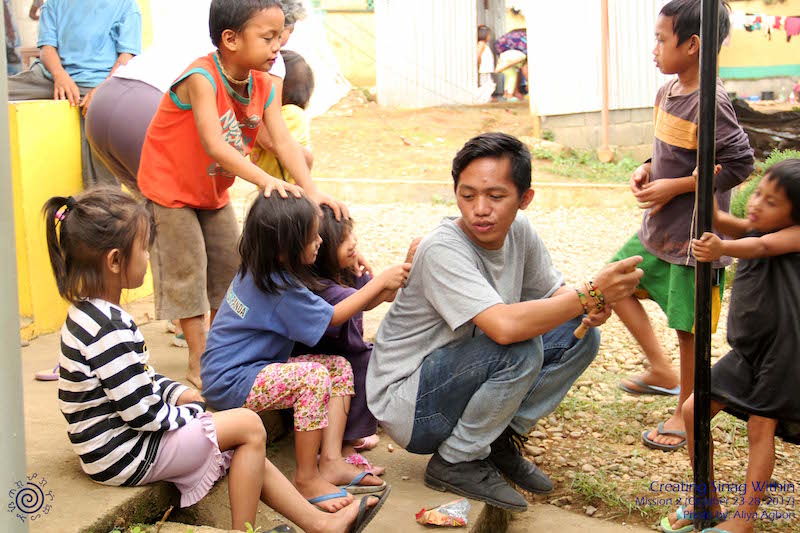 Imad’s recorder playing enamored him with the children who befriended him and followed him wherever he went. Photo by ROSAN ALIYA AGBON
These Courageous Marawi 6 as they would be referred to from then on, found Aliya’s bottoms-up approach refreshing and appreciated that she always listened to their opinions and ideas. She brought them along to the evacuation centers to check what the evacuees really need. Mal says, “It’s great we are her equals. As a volunteer organization, Kids for Peace isn’t cold, isn’t arrogant, and doesn’t assume to know what’s best.”For Aliya, it’s just common sense. The Courageous Marawi 6 are survivors and volunteers and also have light (sinag) in them. “It’s presumptuous for me to assume what’s best for them and for Marawi. Rehabilitation should always be participatory,”Aliya reasons.
She found other collaborators, too. Families from a school in Metro Manila gave crocheted balls for the healing movement games. Farmers from Mindanao donated organic vegetables. A community health center in Kidapawan gave the Courageous Marawi 6 a crash course on the nature of a human being as well as art therapy, organic farming, acupuncture, foot bath, moxa treatment, hilot, kidney and lung compress, body talk, eurythmy massage, anthroposophic medicine. Steiner-inspired educational initiatives in Mindanao also gave inputs on how to facilitate healing movement activities which are known as Emergency Pedagogy.
For two days, the Courageous Marawi 6 trained hard. They then spent six days onsite in Lanao’s evacuation centers working shoulder to shoulder with other experts practicing holistic integrative medicine. All in all, the 26 Creating Sinag Within volunteers visited three evacuation centers and helped 300 medical patients, 200 children, and 20 mothers.
These are the stories of the volunteers:
Kim: “It was probably the first time in their three months of living together in the selter that the evacuees noticed their dirty feet and were embarrassed to let us wash them.”
Audi: “The children were so stiff and shy at first. But by the time we left, they’d loosened up greatly and knew all our names.”
Imad: “The therapies, patients said, made them feel better. They said that despite their pitiful situation, they felt respected as human beings.”
Suli: “Many patients have told me this is the first time they feel volunteers really care because usually volunteers just take pictures, distribute the food packages, then go.”
Bane: “One girl almost had surgery hadn’t our medical team been there and ruled it out after they discovered that there was instead parasitic infection in her digestive system.”
Mal: “One woman was so grateful for my body talk access session that she told me to stop even before I was finished because she was concerned that I may be tired.”
Aliyah: “A day or two after the first consultations and therapies, patients were moving around more and doing chores.”
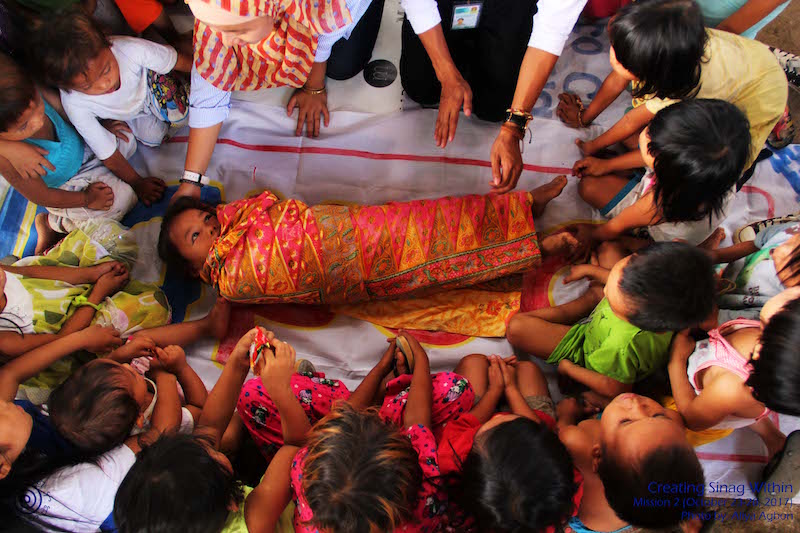 Lying in the center of a circle of love. Photo by ROSAN ALIYA AGBON
Actual relief work is nothing like what they’re taught in school though, according to the Courageous Marawi 6. They only realize now, for instance, that relief thought to be empowering may actually really be debilitating.For instance, evacuees who have been sleeping on cement floor for months have become stiff and rigid from the cold. To help them ease their pains, the CSW team considered cutting some bamboo growing nearby and making them into raised beds. Yet they couldn’t pursue this plan because there were other questions: Who do we ask permission from to cut the bamboo? Who will pay for it? Who will build the beds? And who of all the thousands of sick people should we give the beds to? Imad explains,“If we’re not careful, we could appear abrasive and divisive instead of providing just and fair solutions.”
At the end of this first Creating Sinag Within mission, the team gathered to assess their experience. The unanimous decision: re-group and return in one month to provide patients with follow-up sessions.
The CSW volunteers also strongly feel it’ll be good for the country that government agencies and relief organizations involved in rehabilitating Marawi meet and compare experiences and best practices to learn from each other. Do we relief workers have a genuine desire to help or are we here just to fulfill our need to help? Do the kind and quality of our relief treat evacuees as human beings, not their sicknesses? We certainly don’t want a relief effort to be “cold” and interested only in fulfilling its own agenda, do we? We are rebuilding people, not buildings after all.
***Origin of Kids for Peace
At 12 years old, Rosan Aliya Agbon started Kids for Peace. This was around 2000 during the All Out War by former President Joseph Ejercito “Erap” Estrada. She saw two fighter planes ready to drop bombs. At first she was happy but then she realized the bombs can kill anyone. So she wrote an open letter to ask for peace messages and to make evacuees know that there are people who care. This letter was then emailed by her mother and it was read at a radio station. The first person to respond was a soldier. He gave PhP 500 as his contribution. Soon more contributions poured in from Australia, America, New Zealand, and Germany. They were art supplies and drawings which Aliyah brought and gave to the evacuees in provinces near Cotabato City. To make her increasingly popular initiative official, Aliyah named it Kids for Peace and registered it with SEC. This is how her journey of officially helping others began.
Author’s note: Creating Sinag Within’s Mission 1 in August 2017 and Mission 2 in October 2017 were both initiated by Kids for Peace Foundation, Inc. with support from teachers of Steiner/Waldorf schools in Luzon and in Mindanao and from health workers from various community managed primary health programs in Digos City, Kidapawan City, and Arakan, North Cotabato. College graduates from Tawi-Tawi, Iligan, Cagayan, and Marawi also volunteered during the two Creating Sinag Within missions despite being siege survivors themselves. They felt a compelling need to leave their families, put their job searching on hold, and help out in evacuation centers. For more information about how to support the next activities of Creating Sinag Within, visitfacebook.com/creatingsinagwithinor contact the Founder and Director, Rosan Aliya Agbon at creatingsinagwithin@gmail.com.