DAVAO CITY (MindaNews / 09 October) — “We have been waiting for three years for the passage of the Indigenous Peoples’ (IP) Code of the Bangsamoro Autonomous Region in Muslim Mindanao (BARMM). Perhaps, it is the women they are waiting for, for the code to finally be passed,” Fintailan (women religious leader) Rebecca Mokudef of the Teduray community said.
Twenty-five non-Moro IP women in the BARMM gathered here on October 4 to 6 to reflect on the problems they face and draw their agenda. The women leaders came from the Teduray, Lambangian, Dulangan Manobo, Higaonon, and Arumanen ethnolinguistic groups in the BARMM’s Maguindanao, Lanao del Sur and the Special Geographic Area (SGA) in North Cotabato province.
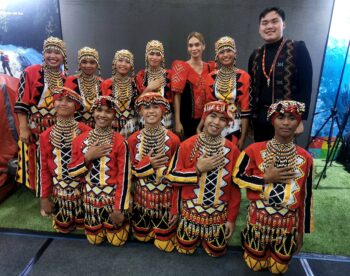
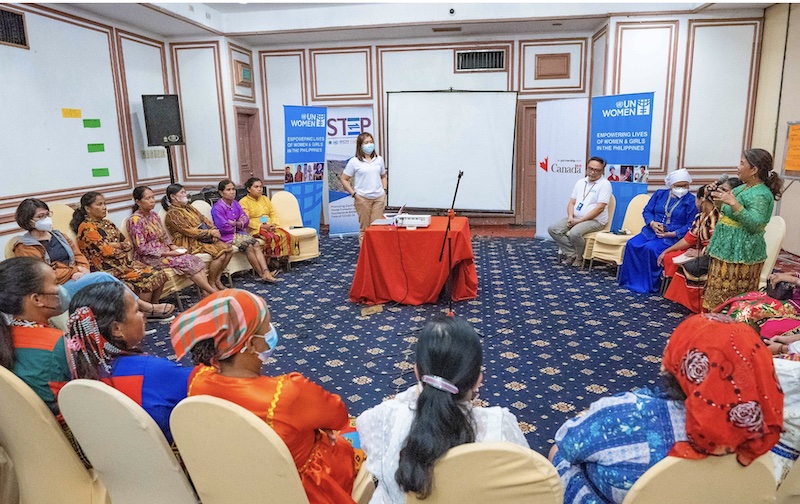 Women among the Non-Moro Indigenous Peoples in the Bangsamoro Autonomous Region in Musim Mindanao air their voices on land rights, development, peace, security and conflict resolution during the capacity building on women, peace and security and policy dialogue on the draft IP Code of the Bangsamoro on 4 to 6 October 2022. Photo by Louie Pacardo / UN Women 2022
Land-based violent conflicts, presence of armed groups, recruitment of children and youth by non-state armed groups, absence of social services, displacements, killing of IP leaders, culture of fear and silence, and lack of freedom of expression were main issues that came out from the discussions.
Major policy recommendations include representation of women in decision-making and conflict-resolution mechanisms, and their participation in the issuance of Free, Prior and Informed Consent (FPIC) for development projects inside ancestral domains.
Before providing policy recommendations to the IP Code of BARMM, the women reflected on the provisions of Republic Act 9710 (Magna Carta of Women), the United Nations Security Council Resolution 1325 on Women, Peace and Security (UNSCR 1325) and the Bangsamoro Regional Action Plan on Women, Peace and Security (RAP-WPS). They also analyzed the Indigenous People’s Rights Act (IPRA) and Republic Act 11054 or the Organic Law for the BARMM. The activity concluded with the identification of the Non-Moro IP women’s policy directions and agenda for integration in the draft Bangsamoro IP Code.
“Through the IP Code, land ownership within ancestral domains can become gender-responsive by ensuring that IP women can own land also so that even when an IP woman separates from her husband especially because of domestic violence, she is not left landless,” Froilyn Mendoza, IP woman leader and now a Member of the Parliament in the Bangsamoro, suggested.
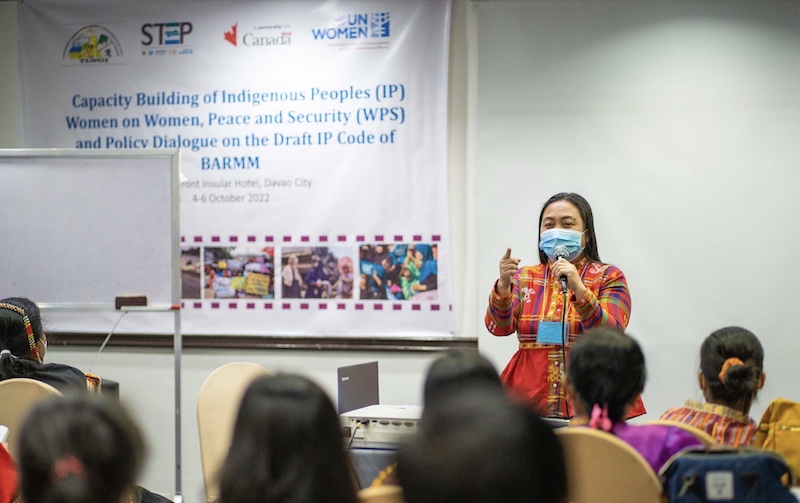 Froilyn Mendoza of the Teduray Lambangian Women Organization, Inc (TLWOI) addresses women leaders of the Non-Moro Indigenous Peoples in the Bangsamoro Autonomous Region in Muslim Mindanao (BARMM) during a gathering in Davao City on October 4 to 6, 2022. She is one of two representatives of the Indigenous Peoples in the 80-member Bangsamoro Transition Authority. Photo by Louie Pacardo / UN Women 2022
“We applaud the Bangsamoro government for the commitment to pursue the rights of all IPs. We also want to ensure that the concerns of the Non-Moro IPs can really be addressed through the IP Code, and Non-Moro IP women will be ensured representation in all important government bodies, in all levels of governance,” Mendoza emphasized.
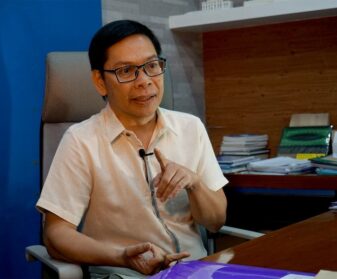
Nery Nuyda Ronatay, UN Women Programme Specialist, said IP women “should not be left behind in the drafting of the IP Code of BARMM. IP women look at the IP Code as a fulfillment of the promise of an inclusive peace process. We cannot fail them.”
The three-day activity was organized by UN Women and TLWOI with support from the United Nations STEP Peacebuilding Fund Phase 3 and Government of Canada. (Carol Bello is Communication for Development Consultant of the UN Women-Women, Peace and Security Programme)