DAVAO CITY (MindaNews / 14 Sept)—The Japan International Cooperation Agency (JICA) will fund a feasibility study on the wastewater management project in Davao City.
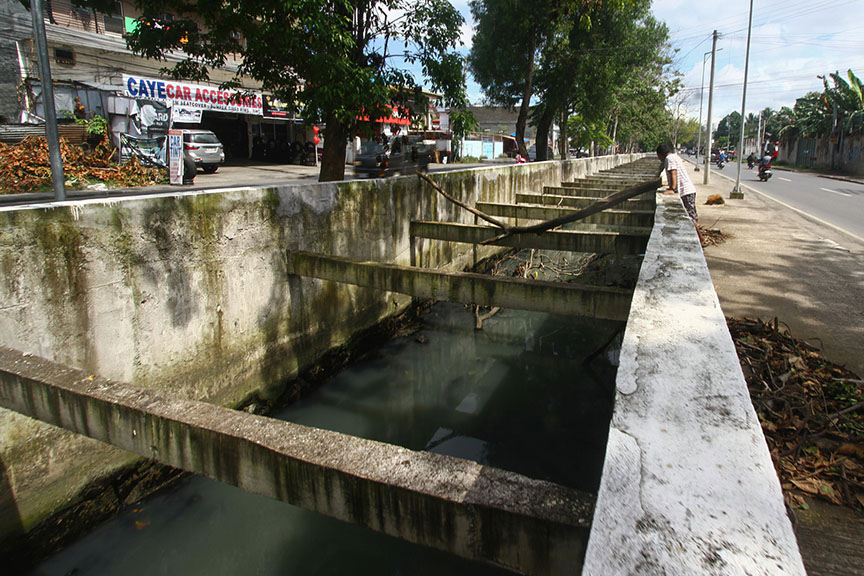 One of the canals in Davao City’s Agdao District where wastewater flows. MindaNews file photo
This after the City Government of Davao and JICA signed last Tuesday the “Records of Discussion” giving a green light to the conduct of a Master Plan Study on the Comprehensive Wastewater Management system.
Engr. Ivan Cortez, head of the City Planning and Development Office (CPDO), told MindaNews on Wednesday that this current undertaking between JICA and the local government would focus on conducting a feasibility study for the project’s sector A, which covers the Poblacion District and Agdao District.
“In 2021, JICA submitted to the city the results of the data collection survey on current systems—or the lack of it—to get a scope of the extent of what needs to be done,” he said.
Cortez said that the local government’s Infrastructure Modernization for Davao City (IM4 Davao) study in June 2018 was “just an initial investigation of what is not present, what is lacking in wastewater management systems and a general identification of systems that must be pursued within the timeframe of the plan” between 2018 and 2045.
Mayor Sebastian Duterte signed the agreement with JICA Chief Representative Sakamoto Takema at the Arcadia Activity Center in Davao, attended by Japanese Consul General Ishikawa Yoshihisa, delegates from JICA, executives from the Davao City Water District, and other city officials.
In a press release issued by the City Information Office, the master plan study, set to commence within this year, will be conducted by a third-party firm chosen by JICA, and will have a three-year timeline consisting of “wastewater management planning, feasibility study for priority projects, and capacity development, among others.”
Duterte acknowledged the need for a “sustainable wastewater management system in the city” as he vowed to support the conduct of the study to ensure “adequate water supply to the city’s growing population while mitigating pollution in the surrounding waters.”
He said that a comprehensive wastewater management has a beneficial impact to the local community, and that efforts must be taken to establish “an effective network to execute the vital steps of data collection, evaluation, and analysis of the current situation.”
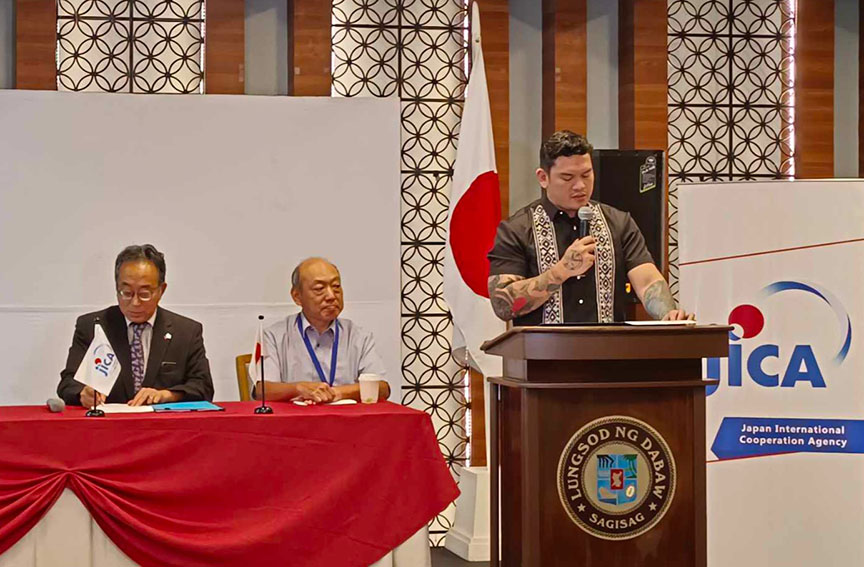 Davao City Mayor Sebastian Duterte speaks during the Records of Discussion signing for the Master Plan Study on the Comprehensive Wastewater Management system. With him are JICA Chief Representative Sakamoto Takema (left) and Japanese Consul General Ishikawa Yoshihisa. Photo from the Facebook page of the Consulate General of Japan in Davao
Takema said that clean water is “very crucial to economy” because it supports sustainable food production, exports, and tourism.
He assured that JICA would assist in the crafting of the best approach to wastewater management.
Takema said discussion between the local government and JICA for a sewage system project began in 2018 as the need for sanitation and clean water supply became more crucial for Davao.
Cortez said results of the study are expected to provide “specific requirements for the implementation of the project and determine the responsibilities and duties of which agencies and service providers.” (Antonio L. Colina IV / MindaNews)