SURIGAO CITY (MindaNews/13 December) — The expedition crew of Research Vessel (R/V) Petrel led by Microsoft co-founder and philanthropist Paul G. Allen has located USS Cooper (Destroyer 695) in its final resting place in Ormoc Bay.
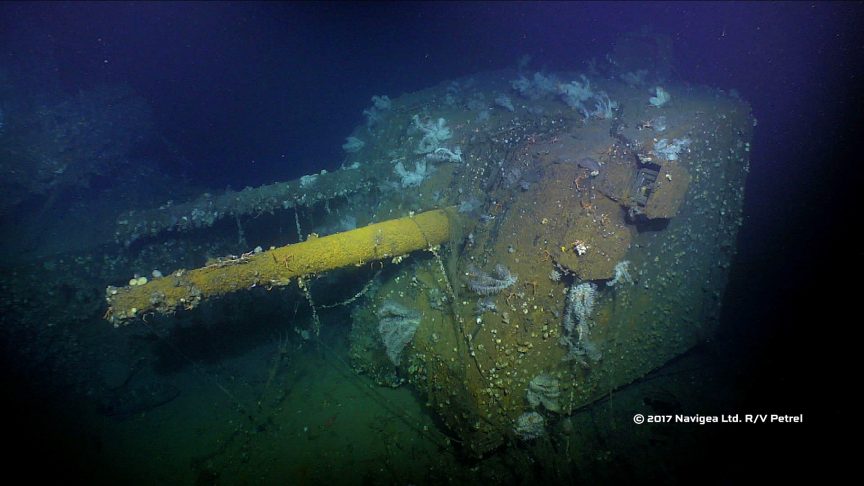 One of the 5-inch guns of the USS Cooper. This one was just aft of the torpedo launcher. Photo courtesy of PAUL G. ALLEN
The Allen-led expedition released the underwater images and video footage of USS Cooper to MindaNews on Wednesday. The wreckage was discovered early this month.
The discovery of an Allen M. Sumner-class destroyer came after USS Ward Destroyer was found in Ormoc Bay early this month too.
Prior to these finds, an expedition found five Japanese warships consisting of two dreadnought battleships (Fuso and Yamashiro) and three Asashio class destroyers (Yamagumo, Asagumo and Michishio) in Surigao Strait on November 22-29.
Director of subsea operations Robert Kraft and deep sea pilot and researcher Paul Mayer both told reporters aboard Research Vessel Petrel last Thursday (December 7) afternoon that they proceeded to Ormoc Bay in search of other warships.
The discovery of the wartime wreckage includes the USS Ward — the American destroyer that fired the first shots in World War II at 6:45 a.m. on 7 December 1941, a Sunday, just before the attack on Pearl Harbor.
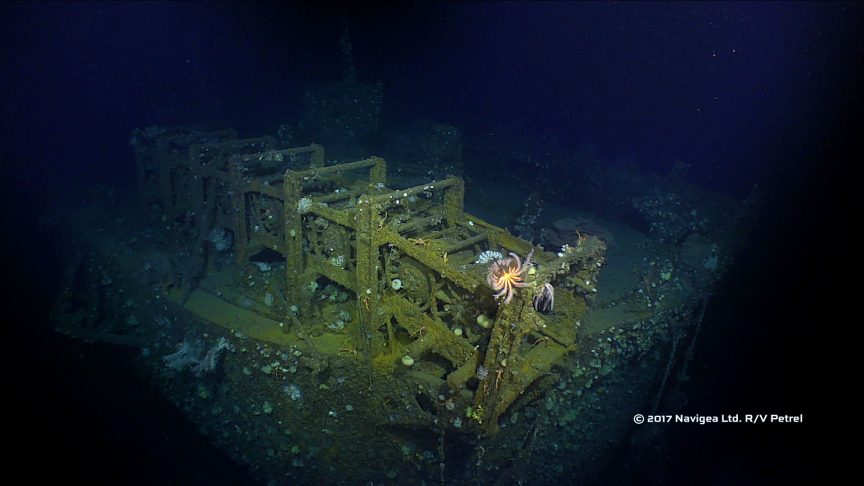 Cooper’s port side depth charge launcher. Photo courtesy of PAUL G. ALLEN
The crew sent its remotely operated vehicle to explore and document the remains of USS Ward on December 1, and released the video in honor of the 76th Anniversary of Pearl Harbor and the men who served there.
USS Ward, a Wickes-class destroyer serving the U.S. Navy, was patrolling the Pearl Harbor entrance on the morning of 7 December 1941, when the officer-of-the-deck spotted an 80-foot-long Japanese midget submarine, trailing the USS Antares into the harbor.
“The USS Ward accelerated to bear down on the submarine. Just three minutes after the first sight of the submarine, the USS Ward fired the first American shot in World War II,” it said.
The enemy air attack on Pearl Harbor, and throughout Oahu, started about an hour after USS Ward sank the midget submarine.
Exactly three years later, on 7 December 1944, USS Ward, then patrolling Ormoc Bay in Leyte, was lost after it was struck by a kamikaze, the name given to Japan’s suicide pilots.
While USS Cooper was sunk down on 3 December 1944 by a torpedo fired by the Japanese destroyer Take. USS Cooper lost 191 men while 168 others were rescued.
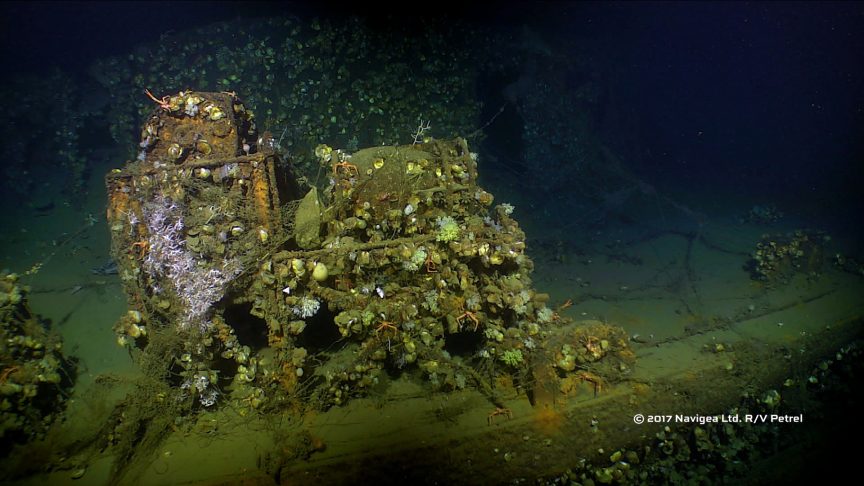 Cooper’s port side depth charge launcher with a depth charge still in place. Photo courtesy of PAUL G. ALLEN
Sometime in 2005, several American technical divers plunged into the remains of USS Cooper for the TV documentary “USS Cooper: Return to Ormoc Bay.” Produced by Bigfoot Entertainment, it made its debut in mid-2006. It featured deep-sea diver Rob Lalumiere and survivors of the Cooper sinking.
Early this month, R/V Petrel, a 250-foot research and exploration vessel found the exact locations of USS Cooper and USS Ward.
Petrel’s advanced underwater equipment and technology makes it one of the few ships on the planet capable of exploring up to 6,000 meters deep (3.
75 miles). Following a 2017 retrofit, Petrel and its crew have been using state-of-the-art underwater technology for deep-sea search and exploration expeditions.
During the November expedition, R/V Petrel captured a video of IJN Yamashiro (FUSO class dreadnought battleship), IJN Fuso (FUSO class dreadnought battleship), Yamegumo (Asashio class destroyer), Asagumo (Asashio class destroyer) and Michishio (Asashio class destroyer). These ships and over 4,000 men were lost during a decisive battle on 25 October 1944 in Leyte Gulf, considered the largest naval battle in history.
The Allen-led expeditions also resulted in the discovery of USS Indianapolis (August 2017), Japanese battleship Musashi (March 2015) and the Italian World War II destroyer Artigliere (March 2017). His team was responsible for retrieving and restoring the ship’s bell from HMS Hood for presentation to the British Navy in honor of its heroic service.
Allen’s expedition team and R/V Petrel are dedicated to continuing exploration, marine archaeology and oceanographic research.
The billionaire tech mogul is interested in collecting and protecting the artifacts that speak of the heroism and service of that day. His recently acquired Petrel provides a platform to search for historic artifacts that were lost at sea. (Roel N. Catoto/MindaNews)