

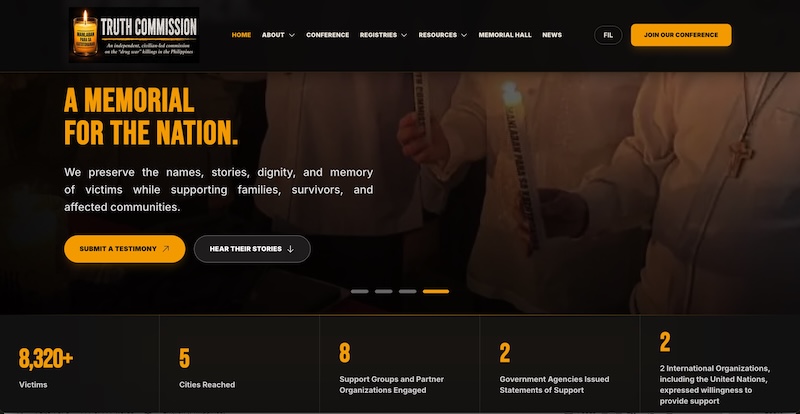
MANILA (Truth Commission) — The Truth Commission will present its first report on Nov. 23 at the Philippine Normal University in Manila. The report names 8,320 people killed in the “drug war” from 2016 to 2022, and it ties each death to a source the public can verify.
It’s by far the most definitive count of those who perished in Rodrigo Duterte’s “war on drugs.” The commission intends to update the data as it continues to do its work.
“A country that cannot agree on the number of its dead cannot properly mourn them, let alone hold anyone to account,” said Dr. Christopher Magno, the commission’s executive director who authored the report, which will be officially released during the commission’s first national conference on Nov 23 at the Philippine Normal University.
A Count Anyone Can Check
The report took six months to produce. It comes one week before Duterte’s trial for crimes against humanity is scheduled to open at the International Criminal Court on Nov. 30.
The commission’s figure sits between the two numbers most often cited. The government’s most widely used figure, 6,252, counts only suspects killed in operations by the police and the Philippine Drug Enforcement Agency through May 2022. It leaves out people killed by masked gunmen and bodies left on roadsides. The ICC prosecutor has cited 12,000 to 30,000 deaths, drawing on several published sources. Commission researchers traced the often-repeated figure of 30,000 and could not find an original count that anyone could reproduce.
“That does not make it false,” Magno said. “It means no one has reconciled the numbers.”
Magno stressed that 8,320 is not the final toll. It is the number of killings the commission can document by name at this time. Magno’s own research on patterns of violence supplied 7,893 of the cases. Program Paghilom and Caritas Kalookan added the remaining 427 from church and survivor-support records. Each entry in the commission’s Victim Registry lists the victim’s name and where he or she died, along with age where known.
Who Died, and Where
Men made up 96.6 percent of the victims. Where age is known, four in five were between 25 and 54. Sixty were children. The youngest, Marjon Ocampo, was 1 year old.
Killings were recorded in 730 of the country’s 1,633 cities and towns. Metro Manila and Central Luzon, home to less than a quarter of Filipinos, account for 56 percent of the dead. In North Bay Boulevard North in Navotas, about one in every 550 residents was killed.
The killings began in nearly every region within weeks of July 2016. Magno said that pattern points to a single national trigger, not violence spreading on its own.
The Killings Tracked Police Involvement
When the police were pulled from the campaign in January 2017, documented killings fell by 58 percent. Killings attributed to the police dropped by 91 percent. When the drug enforcement agency took sole charge in October 2017, killings fell by 78 percent. They rose again each time the police returned. Arrests held steady at 4,000 to 5,000 a month through 2022.
The commission also questioned the official claim that suspects fought back. Its news archive records nine officers killed by ordinary drug suspects from 2016 to 2020, against 1,269 people killed in police operations in the commission’s data. Of 805 news accounts of buy-bust operations, 781 ended in death. Where the method is known, 99.5 percent of the killings were shootings. Dr. Raquel Fortun, a forensic pathologist on the commission, examined the exhumed remains of 46 victims and found that 24 had been shot in the head.
Gaps in the Official Record
Researchers found case files that could not be opened and reports that gave the same person different names and ages, Magno said. On Nov. 9, the commission asked the Professional Regulation Commission to investigate the doctors who signed death certificates for 13 victims.
The report sets out 27 reforms drawn from families’ testimony. It singles out five as urgent: preventing deaths in custody, responding to threats, protecting witnesses and families, preserving evidence and correcting death records. Twelve existing laws and issuances already cover the duties families described, the commission found, but they are not enforced.
The Victim Registry is public and will continue to grow. The commission will correct any entry that a family or researcher shows to be wrong.
“Each of the 8,320 is a person the country has a duty to name,” Magno said. (Truth Commission*)
*The Truth Commission is an independent, civil society-led body tasked to find out the truth about “drug war” killings in the Philippines, restore dignity to the victims, and foster healing and reform.


