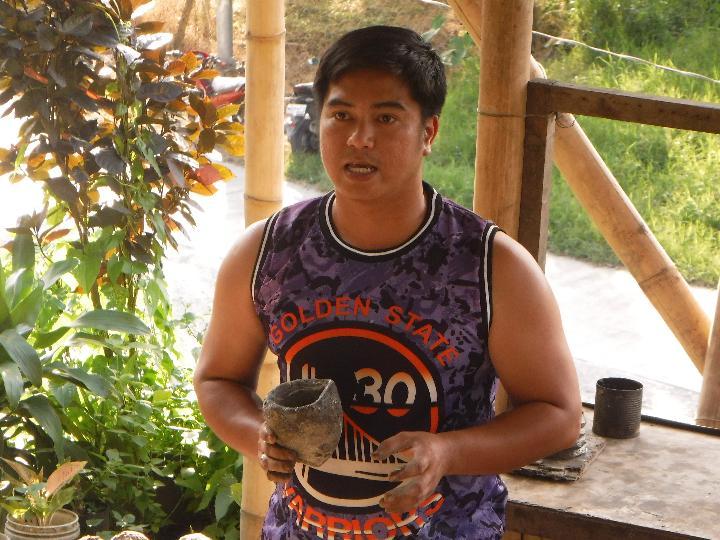
LAKE SEBU, South Cotabato (MindaNews / 20 November 2026)— What some consider scrap metal can become something precious in the hands of a Tboli brass caster.
Damaged gongs and discarded brass sourced from junkshops are given new life through traditional casting, transformed into belts, bracelets, medallions and other ornaments that have long formed part of Tboli identity.
But while the materials can still be found, the knowledge and skills needed to transform them into cultural heirlooms require years of practice, something Tboli elders are now working to pass on to a younger generation.

Jefferson Fara, 35, son of master brass caster and Gawad sa Manlilikha ng Bayan awardee Bundos Fara, said Tboli elders have been holding discussions on how to revive the craft, particularly through their local tourism sector.
“There are really meetings among the elders, especially in our tourism sector, because we want to bring it back. Almost everything has already disappeared here in brass casting,” Fara said.
The concern goes beyond preserving a traditional livelihood. Brass casting is part of what makes the Tboli distinct.
“We really need to encourage the youth to do brass casting because this is one of the identities of the Tboli, from before until now,” he said.
Brass accessories have long carried meaning within Tboli society. Belts and other ornaments worn as part of traditional clothing could signify wealth or belonging to a noble family.
“Pag meron kang mga accessories na suot sa amin, it means mayaman ka, rich family, or nasa noble family ka,” Fara said.
(If you’re wearing accessories coming from us, it means you’re rich, a rich family, or belonging to a noble family.)
A craft forged through patience and fire
The difficulty of keeping the tradition alive becomes apparent in the process itself.
Tboli brass casting uses the traditional lost-wax method, locally known as kem tau temwel. Artisans carve intricate designs into wax before encasing them in layers of clay to create molds for molten metal.
In a May 2024 feature for Vogue Philippines titled “Metal in the Blood,” journalist Audrey Carpio documented the work inside Bundos Fara’s workshop, where his son Jayson Fara spent five days carving a wax medallion decorated with intricate patterns.
The process begins with shaping and etching wax by hand. The design is then covered with layers of clay and other materials to form a mold. Once heated over charcoal, the wax melts away, leaving a hollow space into which molten brass is poured. After the metal cools, the clay casing is broken to reveal the finished piece. Each mold is used only once.
The process requires patience, precision and considerable physical effort. A mistake in preparing the design or mold can mean losing hours or even days of work.
The materials themselves also reflect the resourcefulness behind the craft. Rather than relying solely on newly manufactured metal, Tboli brass casters recycle broken agong, or gongs, and other scrap brass instruments, while sourcing additional materials from junkshops.
A May 2025 report by the South Cotabato provincial government documented Bundos’ work and the challenges of producing brass ornaments, including the purchase of scrap bronze from junkshops at around P20 per kilogram.
Decades of working around open flames have also taken a physical toll on master artisans. In the Vogue Philippines feature, Bundos recalled that his eyesight had deteriorated after years of working near intense heat.
Jefferson said the process also carries occupational risks, particularly during the operation of fire and the handling of tools and equipment used in cleaning and finishing cast products.
He explained that aspiring practitioners must first spend months or even years learning to work with wax before advancing to the actual casting process. The work requires familiarity with the materials, equipment and safety precautions to avoid injuries, including cuts from sharp edges during the cleaning of finished products.
He also described traditional precautions observed by practitioners when handling water after working near the fire, including avoiding cold water. Such practices form part of the knowledge passed among artisans.
Making the craft accessible to the youth
Despite the demanding process, Jefferson said the younger generation should not simply be described as uninterested in brass casting.
“It is not that they are uninterested. They have not yet seen the true value of brass casting,” he said.
To encourage participation, their current training initiatives provide incentives to young learners, including free transportation, allowances, snacks, and meals.
Fara said participants initially focus on learning how to make wax designs before proceeding to more advanced stages of brass casting.
The approach is intended to make the craft more accessible while allowing young people to develop their skills without immediately shouldering the costs of training.
He also emphasized the importance of support from the National Commission for Culture and the Arts (NCCA), particularly in providing funds to ensure that the knowledge and skills of master artisans are passed on to future generations.
The effort to revive brass casting is also being linked to government and tourism initiatives, with cultural preservation expected to become a stronger component of programs for the next generation.
Fara said the government, through NCCA assessments and coordination with the local tourism sector, is looking at ways to ensure that traditional skills continue to be passed down.
By 2027, he said, the plan is to strengthen the implementation of cultural skills preservation in every Living Tradition Center; however, preserving Tboli culture cannot stop at displaying traditional objects or teaching young people how to produce crafts for tourists.
“It means the skills should still be alive until now, not only the tangible,” he said.
That includes chants, dances, healing practices, and traditional music, alongside crafts such as brass casting.
The Living Tradition Center is envisioned as a space where younger generations can learn these practices and keep them part of community life, rather than allowing them to survive only through exhibits and documentation.
For the Tboli community, keeping these traditions alive means ensuring that there are still young people who know how to make, perform, and practice them.
A broken gong may find its way into a junkshop, but in the hands of a Tboli craftsman, it can become an ornament carrying the identity of a people.
The brass may survive through recycling. The greater challenge is ensuring that the knowledge, patience and hands needed to shape it will survive, too. (Justine Paul Paraz / MindaNews)