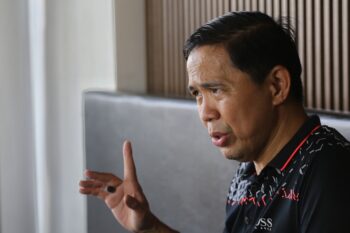
DAVAO CITY (MindaNews / 23 November 2026) – Fugitive Senator Ronald “Bato” Dela Rosa is asking the Senate Committee on Ethics and Privileges to drop the complaints filed against him over his prolonged absence from official duties, saying his inability to attend in person is an “exceptional response to an exceptional circumstance.”
In a 27-page answer to the letter-complaint filed by Wag Kang KuCorrupt, Barry Gutierrez, and Maria Cielo Magno, et. al., Dela Rosa maintained that his prolonged absence from the Senate does not constitute a violation of any rule or provision of the 1987 Constitution.
Dela Rosa’s counsel, Israelito Torreon, shared a copy of Dela Rosa’s answer with reporters via Viber on Sunday.
“His present inability to attend in person is an exceptional response to an exceptional circumstance, in which a credible threat to his liberty required heightened legal caution and the protection of his constitutional rights,” the senator’s answer reads.

Dela Rosa, who is the subject of an arrest warrant issued by the International Criminal Court (ICC), has been in hiding since he slipped out of the Senate on May 14, just hours after shots were fired inside the building.
Following the incident, the ICC classified Dela Rosa as a “suspect at large” while the Philippines’ Department of Justice has declared him a “fugitive from justice.”
Dela Rosa has been named a co-perpetrator in the crimes against humanity by the International Criminal Court (ICC), in connection with the bloody campaign against illegal drugs in the previous Duterte administration.
He said his absence from the Senate is not a pattern, stating that he maintained full attendance in plenary sessions and official business before the ICC ordered his arrest.
“The circumstances that underlie this complaint also bear on the Senate’s institutional responsibility. No Filipino, whatever his rank or former office, should be brought before a foreign tribunal except in strict adherence to the Constitution, the laws, and the full protection of due process. Sovereignty is not an abstraction. It is the assurance that every citizen stands first under the protection of Philippine law, and of Philippine courts, before any external authority may claim him,” he said.
The complainants, Dela Rosa said, have failed to show competent evidence on allegations of his willful abandonment of legislative functions, misuse of public funds, or any institutional breakdown.
The Senate’s power to discipline its members, Dela Rosa said, is both a serious constitutional power and essential component of legislative independence, which must be exercised with restraint, on clearly defined standards, and on concrete evidence.
Members of the civil society group filed a complaint with the Senate Committee on Ethics and Privileges against Dela Rosa on February 25, 2026.
The complaint, however, was returned on May 4, 2026, on the ground of failure to substantially comply with Section 17 of the Rules.
Five supplemental affidavits were then filed with the Committee on September 14, alleging, among others, that Dela Rosa’s prolonged absence without leave is a “clear dereliction of duty” and that the senator only reported for work once to cast his vote for a leadership change in the Senate on May 11, since he went into hiding on November 11, 2025.
Dela Rosa believed his absence from the sessions is not a culpable violation of the Constitution.
“Respondent did not choose between attending the Senate and staying away for his own convenience. He faced, and faces, the prospect that if he appears in a public place he will be arrested on a foreign warrant and removed from the Republic before any court of the Philippines can rule on the legality of his surrender. That is precisely what befell former President Duterte on 11 March 2025,” he said.
Dela Rosa claimed he is not hiding from Philippine courts and that his action challenging the enforceability of the ICC warrant remains pending with the Supreme Court.
“A citizen who invokes the jurisdiction of the Supreme Court to determine whether he may lawfully be surrendered to a foreign tribunal, and who meanwhile declines to place himself in a position where the question would be rendered moot by his removal, is exercising his constitutional rights to liberty and to due process. He is not committing an ethical offense,” he stated. (Antonio L. Colina IV / MindaNews)