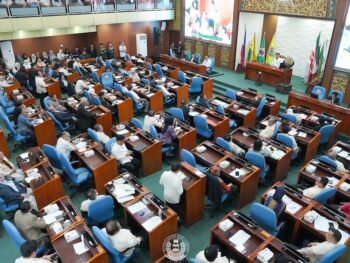
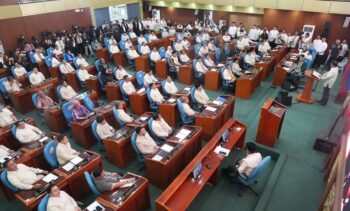
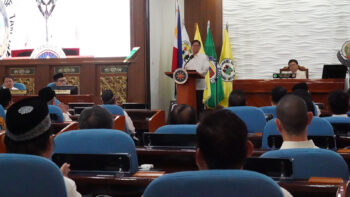
DAVAO CITY (MindaNews / 27 November 2026) – Six sectoral representatives in the 80-member Bangsamoro Parliament pushed for additional committees for the sectors that they represent — Settler Communities, Women, Youth, Traditional Leaders and Ulama — arguing that they have specific concerns that would necessitate their creation but the proposal was turned down by the Government of the Day (GOTD).
The GOTD had listed among the statutory committees the Committee on Women, Youth, Children, and Persons with Disabilities. In its session on Tuesday, November 24, the Opposition, including the six sectoral representatives, proposed a separate Committee on Women and Committee on Youth, and committees for Settler Communities, Traditional Leaders and Ulama Affairs, that would “be chaired by the duly elected Sectoral Representative representing the corresponding sector.”
The proposal was earlier contained in the Opposition’s comments to the Standing Orders or parliamentary rules proposed by the GOTD, the Coalition of 51 that voted Abdulraof Macacua as Chief Minister. The Opposition comprises the 27 who voted against him. During the election of Chief Minister at the inaugural session on October 30, one abstained and another was absent.
The GOTD denied the proposal in their comments and during the plenary on November 24 that deliberated on the proposed resolution adopting the Standing Orders.
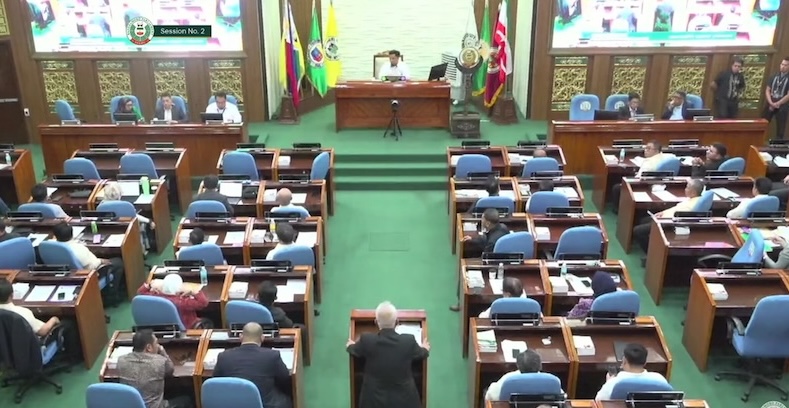
The Bangsamoro Parliament has 40 party representatives, 32 single district representatives and eight sectoral representatives.
Of the eight sectoral representatives, two are for the Non-Moro Indigenous Peoples (NMIP), two for Settler Communities, and one each for Women, Youth, Traditional Leaders and Ulama.
Among the eight, only the NMIP representatives were chosen by their sector through their own customary practices. The NMIP is the only sectoral representation in the GOTD.
The six other sectoral representatives were elected at large under the United Bangsamoro Justice Party (UBJP), the political party of the Moro Islamic Liberation Front (MILF). They are among the 27 who did not vote for Macacua but voted for MILF chair Ahod “Al Haj Murad” Ebrahim as Chief Minister.
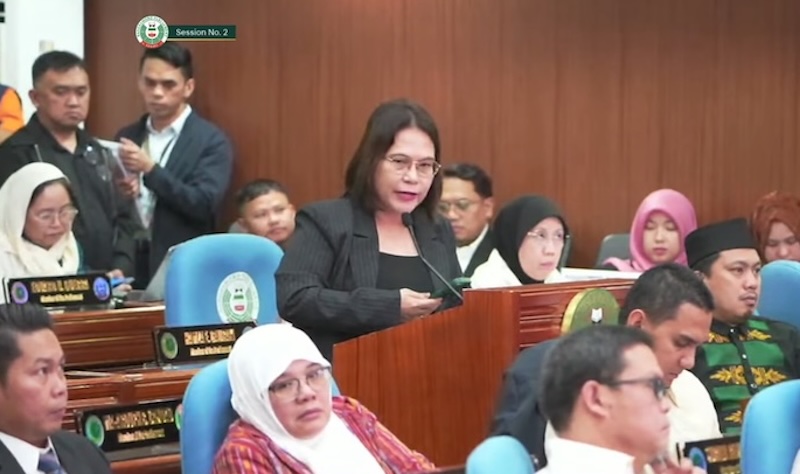
MP Mary Ann Arnado, Settler Communities Representative, asked if the GOTD would be open to the creation of new committees so that the specific interests of the sectors will be accommodated.
“If we don’t have a specific committee, if I will file a certain bill for the settler communities, to whom shall we refer that committee, that particular bill? So I hope that we will be open, we will be mature enough to accommodate the new sectors, like for example, the Women, the Settlers, we have the Ulama and the Traditional Leaders,” she said, adding that the NMIP’s have a Committee on Indigenous Peoples’ Affairs.
The eight reserved seats are based on the Comprehensive Agreement on the Bangsamoro, the peace agreement between the Philippine Government and the MILF that was signed in 2014 and paved the way for the creation of the Bangsamoro Autonomous Region in Muslim Mindanao (BARMM), and its enabling law, Republic Act 11054 or the Organic Law for the BARMM.
From Office of Settler Communities to Ministry
During the MILF-led Bangsamoro Transition Authority (BTA) from February 2019 to March 2025 under Ebrahim as Chief Minister and from March 2025 to October 30, 2026 under Macacua, the only committee representing a sector was the Committee on Indigenous People’s Affairs, which is among the committees under the elected Parliament. The NMIPs also have a Ministry of Indigenous Peoples’ Affairs while the Settler sector only has an Office for Settler Communities attached to the Office of the Chief Minister.
Transforming the Office for Settler Communities into a Ministry was proposed during the transition period. “So that is a long, long proposal that did not succeed, did not pass in the transition in the BTA. But we are hoping that we can push again with this Regular Parliament,” Arnado said.
Deputy Floor Leader Naguib Sinarimbo (Bangsamoro Federalist Party / GOTD) said this proposal can be referred to the Committee on Amendments as this would require amending the Bangsamoro Administrative Code.
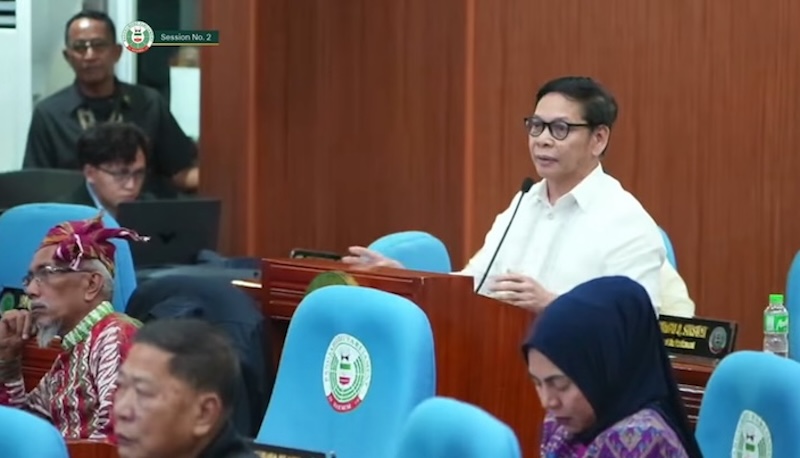
He asked Arnado for samples of other concerns they are raising, responding to each of them by citing the existing committees that could be referred to.
MPs Aida Silongan, Sulffy Abbas and Marjanie Macasalong, the sectoral representatives for Women, Youth and Traditional Leaders, respectively, also stood up to push for the creation of sectoral committees, among other concerns, but MP Muhammad Nadzir Ebil, the Ulama sectoral representative, was not able to speak as the period of interpellation had been terminated.
MP Yul Olaya, the other representative of Settler Communities, asked how the rights of the minority could be preserved when their representation in the committees is just 25% of the regular members, there are no vice chairs from the Opposition and they do not have committees for the sectors.
Olaya noted that having only 25% membership in the committees instead of proportional representation is just short of saying “manahimik na lang po kami” (just keep quiet).
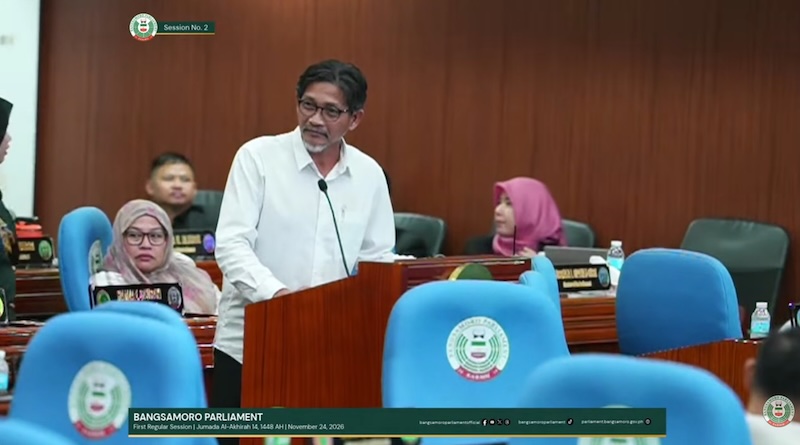
Sinarimbo moved to strike off the record the “unparliamentary remark that ang intention ay manahimik na lamang. That’s never the intention.” The motion was approved.
The sectoral representatives, along with the rest of the Opposition, pushed for proportional representation in committee memberships
In the Bangsamoro Parliament, it’s “Government of the Day” for the majority and “Opposition” for the minority
Sinarimbo, who served as BARMM Minister of Interior and Local Government from 2019 to December 2023, and was recently appointed as Education Minister, said it is important to understand the foundational concept in a parliamentary system of having a ruling party that governs and an opposition, that members of the GOTD will have to advocate, pass legislations and approve motions while those in the Opposition are “not supposed to imagine governing and passing legislations. Your role as the Opposition is to check the proposals of the majority.”
“Why is that? Because you cannot pass a legislation or approve a motion if you do not have the number. Your guaranteed right therefore is to speak and to oppose … This is the Westminster model of parliamentary system. We cannot crisscross lines.”
He said there is a need to understand that the specific role of the Opposition is “to make representation and point out your issues. But you cannot demand that you become part of government. If you wish to do so, if you are a party, then you have to affiliate in the coalition so that you become part of government. You can chair committees then. But that is not the intention here. The intention is for you to serve as the Opposition and to try to check the Government of the Day’s proposal.”
Olaya asked that if the Opposition proposes a law that will benefit the Bangsamoro, especially the sectors, “hinding hindi po yan makakapasa dito sa Parliament na ito (that will not pass in this Parliament) only because we are a minority?”
Sinarimbo replied that the Opposition has to convince the GOTD to sponsor that and get their votes “because that’s how Parliament works. If you do not have the votes, you cannot have it legislated.”
He said they have colleagues who were MPs during the transition period and were part of the Minority then and understand how legislation in a collegial body operates. “No matter how good the proposition is, if you are not able to convince the ruling party, the majority, you cannot have anything passed,” he said.
“And let us not paint a picture of as if because we are a minority, we are being oppressed. The simple proposition for that is that if you want to govern, you decide to be part of the … governing party so that you can be in the Government of the Day. If you are in the Opposition, you have to accept the role of the Opposition which is to maintain the checks in the Parliament … and we have provided that in the rules to ensure there would be a voice at every stage of the proceedings in the parliament,” he said.
Deputy Floor Leader Ishak Mastura (Bangsamoro Federalist Party / GOTD) stood up to say he does not want Olaya to come out of the debate with a grievance. “We don’t want that they will feel that they have not been given the chance to assert that right.”
“We don’t want that in his heart or in our hearts that there is anyone here who will feel that they have been oppressed,” he said.
He said he just wants to put on record that the sectoral representatives are representing their party, the UBJP. “Ultimately, he carries the constituency of the UBJP because each party here that participated in the elections also had their sectoral representatives” but UBJP won the six sectoral seats for five sectors.
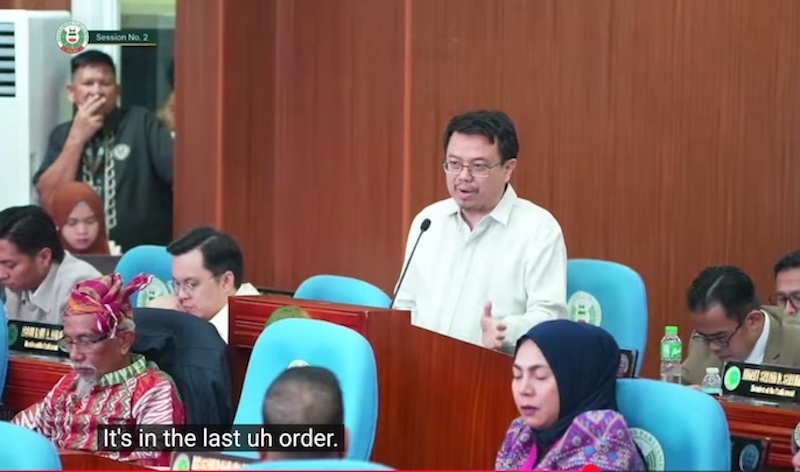
“He carries his party. Yun ang first representation niya. Let us disabuse ourselves that he is sitting here as a sectoral representative, represents the entire sector because the whole Bangsamoro voted them.Principally, the face that they put on the table here is that they are the UBJP party mates and that they are toeing the UBJP party line. That is party-based democracy,” Mastura said.
Arnado interjected, clarifying that her representation is “as sectoral representative for the Settler Communities, I am not representing the UBJP. That’s very clear.”
“In fact, in the way we work, we are not working just for UBJP. Our party is UBJP but we represent our sector and we do not look at any party lines. We cater to all members of the sector. I hope that is clear. And in the discussion now, I don’t bear any grievance. I am very, very seasoned in litigation. I know what is debate. And so we can debate and debate, of course, without hurt feelings. We can do that. And as a matter of fact, I am preparing my proposed amendment without also any expectation of any change of heart. But … that’s life. That’s how the parliament works. And so please don’t also try to you know, egg something that is not there. We don’t have any grievance here. We are very, very sport. So no offense, very, very collegial. We’re good. So keep it up. Thank you.”
None of the amendments proposed by the Opposition at the plenary was accepted. The resolution adopting the Standing Orders was passed at 11:56 p.m. on November 24.
“New carabao in town”
The need for a better understanding of how a parliamentary system works and what the roles of the GOTD and the Opposition are in the Bangsamoro Parliament is evident from the debates during the October 30 and November 24 sessions.
The First Bangsamoro Parliament comes after a transition period that spanned seven years and eight months. During this period, the interim Bangsamoro Parliament adopted a “hybrid” parliamentary and presidential system of governance even as the peace agreement provided for a parliamentary system under a presidential form of government.
Cotabato City-based Professor and book author and translator Mansoor Limba, in his “Marginalia” column for MindaNews on November 25 wrote about how, “for generations, we have been accustomed to the political ways of a presidential system” and “now, by virtue of a peace agreement and an organic law, we have a parliamentary government within a presidential republic.”
“It is our new carabao in town,” he said, adding that there is a need to “familiarize ourselves with its salient traits and peculiar demeanors. We need to know which of these traits are inherent in parliamentary government, which are peculiar to certain countries, and which we have yet to cultivate in our own setting. And by ‘we,’ I mean both the voters and the voted for.”
“Our parliamentary education should not have ended on September 14, the day we cast our votes. In fact, that may have been only our first day of class,” he said. (Carolyn O. Arguillas / MindaNews)